
A real estate investment project without chaos
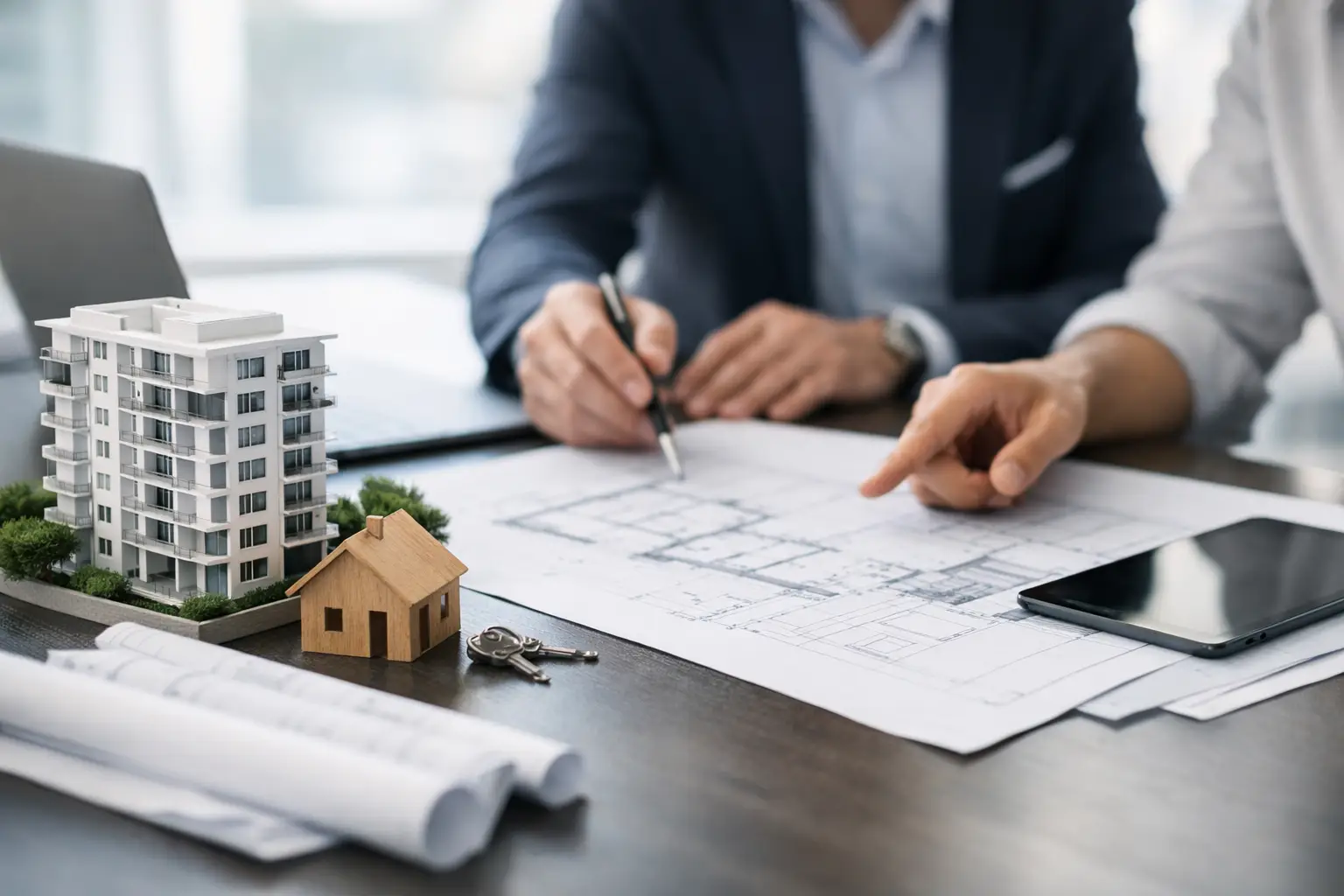
The decision to enter into a real estate investment project rarely begins with the plot itself. It usually starts earlier – from the question, or a given location, function and scale have real potential, and not just look good on a spreadsheet. It is at this stage that the advantage is created: not in investment courage alone, but in the quality of the assumptions.
In practice, the best projects are not the result of one strong idea. They are the result of a precise combination of architecture, investment economics, user experience and execution discipline. When any of these elements are treated separately, the risk of costly corrections increases, delays and loss of value. And yet the purpose of the investment is not only to complete the facility. The goal is to create space, which will operate on the market, functionally and aesthetically for years.
What a real estate investment project really is
A real estate investment project is not just a plan to build or purchase an asset. It's a holistic process, which includes business logic, design decisions, analysis of the environment, model of space use and method of implementation. In a mature approach, real estate is not just a product. It is a tool for generating value – financial, operational and image.
Therefore, project evaluation should not end with a simple question about the rate of return. This is equally important, whether the facility responds to real demand, whether it can be implemented effectively and whether its quality will support sales, rental or long-term retention of value. Profitability and design are not on opposite sides. When done well, they reinforce each other.
From concept to result
Most errors appear then, when the investment develops sequentially: first a quick purchase, then the initial vision, later the project, and finally nervous adjustment of the budget. This arrangement almost always leads to compromises, that reduce quality or margin.
Integrated thinking from day one gives much better results. This means a parallel look at plot potential, planning parameters, target group, architecture standard, implementation cost and target commercialization strategy. When these layers are analyzed together, it's easier to make the right decisions before they become expensive.
That's why investors are increasingly looking for a partner, who understands both the project language, as well as the logic of real estate development. Good architectural design alone is not enough, if it does not translate into a smooth process and a strong end product. On the other hand, calculation alone is not enough, if the final space is not of quality, that attracts users and builds an advantage on the market.
What determines this, that the project makes sense
What matters at the beginning is the compatibility between the location and the investment program. Not every plot should become an apartment building, not every property is suitable for mixed-use and not every commercial space will meet the high standard of finishing. The potential of a place needs to be read more broadly – by the urban context, availability, the nature of the environment and the profile of the future user.
The second pillar is scale. A scope that is too ambitious may overwhelm funding, extend implementation and increase exposure to market changes. Being too conservative may mean not realizing the full value of the land. Good scale is not a compromise. It is the result of a conscious balance of risk and opportunity.
The third area is the quality of space. This is an element that is often underestimated by these people, who only look at numbers. Meanwhile, the functional layout, proportions, daylight, the quality of common areas and the standard of interiors have a real impact on the pace of sales, the level of rates and the perception of the investment brand. In the premium segment, it's obvious. In the medium segment – equally important, although often less spectacular.
Real estate investment project and risk control
Every investment carries risk, but not all risks are the same. Some of them can be predicted and limited already at the preparation stage. This applies especially to planning risks, formal, costs and implementation.
In practice, it is not usually the problems themselves that are the most expensive, but a moment, in which they are noticed. If plot restrictions, an illegible functional program or an overly optimistic budget come to light only after the project has advanced, the investor loses time and flexibility. That's why the pre-design stage is so important. This is when it is worth testing different scenarios, rather than falling in love with the first version of the concept.
Reasonable project management also means decision-making discipline. Not every change improves the investment. Sometimes a new solution looks attractive, but it complicates execution or increases the cost without any real impact on the market value. A filter is needed, that separates decisions that build quality from these, which only multiply the effectiveness.
Design as a tool of values, not decoration
In real estate, design is treated in two ways: or as an unnecessary cost, or as a marketing addition. Both approaches are too shallow. A well-conducted design process brings order to the investment, it gives it coherence and allows for better use of the potential of the place.
It is in architecture that the decision is made, how the building will fit into its surroundings, how its function will work and how the user will perceive the space. It's in the interiors a standard materializes, that affects perceived value. And it is in the coordination between these areas that the advantage arises, which cannot be easily copied.
For the investor, this means a specific effect: fewer random decisions, greater product readability and better control over the entire implementation cycle. In the integrated model, the design does not end with aesthetics. It becomes a tool for conducting investments. This is where architecture meets, The most mature teams work in interior design and development thinking, including the approach developed by QCA.
Where the project most often loses value
Loss of value rarely results from one spectacular mistake. More often than not, it is the sum of small omissions: incorrectly set brief, imprecise budget assumptions, poor industry coordination or material decisions made too late. Each of these shifts may seem small on its own. Together they slow down, quality and profitability.
Another common problem is the division of responsibility between too many entities. When the concept is created in one place, executive design in the second, and investment assumptions are developed separately, it's easy to lose coherence. As a result, the investor manages more than one vision, but a set of partially conflicting interests. To model, which generates friction.
It doesn't mean that, that each project must be conducted identically. There are investments, that require more flexibility, and such, that need strict standardization. The key is here, so that the structure of the team and process is adapted to the scale, asset class and expected result.
How to think about time, budget and ambition
The most successful investments are neither overly cautious, nor overly spectacular. They are precisely positioned. Knowledge, where it is worth investing more, and where it is better to simplify solutions without compromising the final quality.
Time and budget should not be treated as constraints imposed on the project from the outside. To parametry, that need to be built into the concept from the beginning. If the investment has a specific sales horizon, level of financing and target group, the architecture and finishing standard must support this logic. Ambition is valuable, but only then, when it leads to a business-defensible result.
This also applies to phasing. In some projects, it is profitable to divide the implementation into phases, to better manage capital and demand. In others, staging weakens consistency and increases operational costs. There is no one model for everyone. There is a need for conscious choice, based on the realities of a specific property.
Investor's perspective, who thinks long term
Today, more and more investment decisions are made with greater caution than just a few years ago. This is a good direction. The market rewards well-thought-out projects, well placed in context and conducted with consistency. There is less room for chance, and more on the quality of the process.
For an investor, this means a simple change of perspective: instead of just asking, how much can be built, it's worth asking, what is worth building and in what form it will work best. This difference in thinking changes everything – from the first sketch to the final result.
A good real estate investment project does not promise spectacularity at any cost. It offers something much more valuable: cohesion, predictability and space, that makes sense for the market and for people, who will use it. And that's usually the best starting point for lasting value.