
A development project without costly mistakes
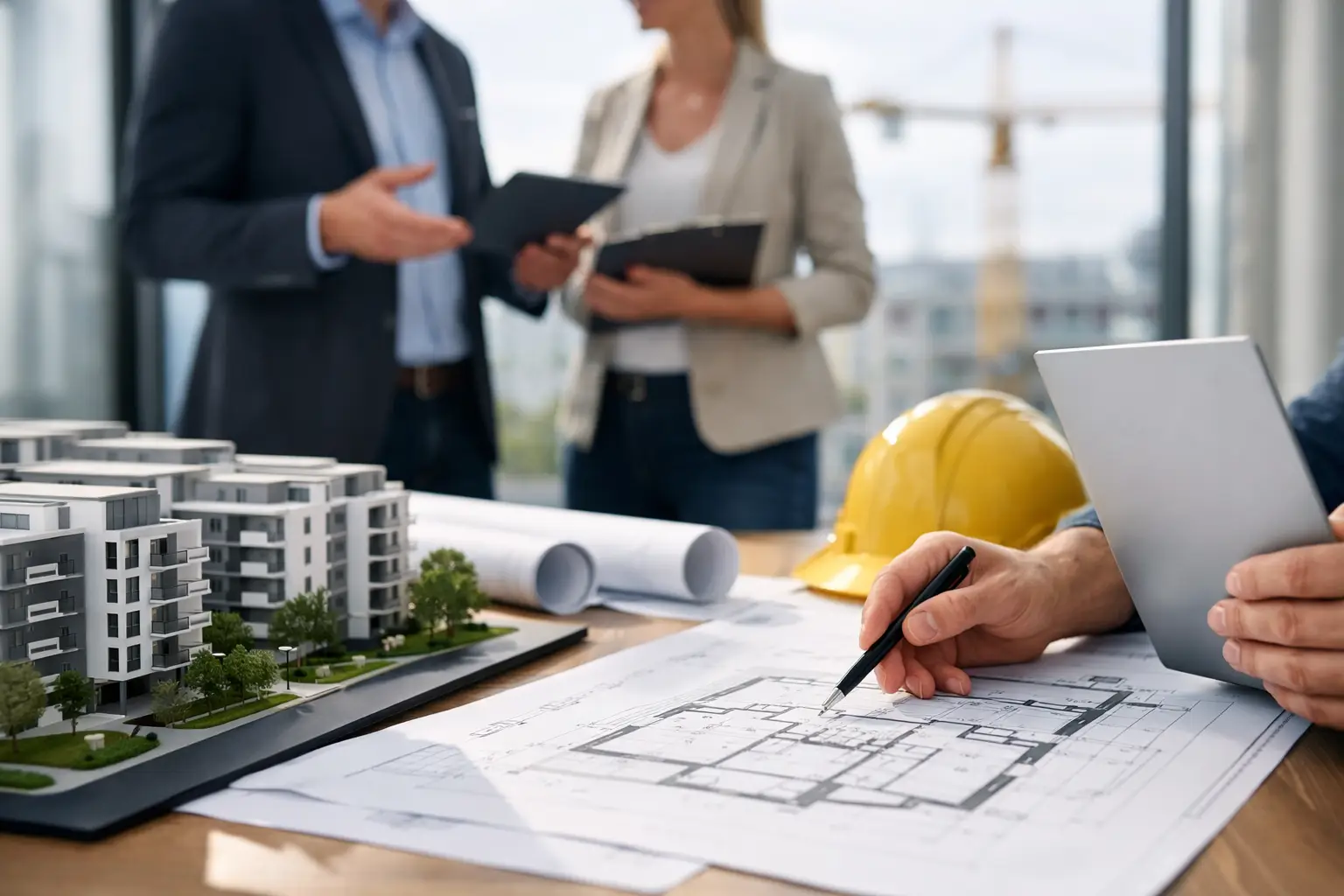
Every development project begins much earlier than the construction stage. Its success is not determined solely by a good plot of land, impressive architecture or an efficient general contractor. The most value – or the most losses – is created in a moment, when the investment vision meets market realities, planning, costs and speed of decision-making.
This is a key moment for the investor. Most often invisible to the future user. And this is where the decision is made, whether a coherent object will be created, attractive and profitable, or project, which from the very beginning will require compromises that reduce its quality and sales potential.
What a development project really is
In practice, a development project is not just a construction project. It’s an investment process, in which architecture, urban planning, interior, finances, the commercialization schedule and strategy must work as one system. When these areas are run separately, typical problems arise: an attractive concept without economic justification, a well-calculated financial model without a distinctive quality of space or efficient implementation of the investment, which does not create a market advantage.
The best projects don't try to choose between design and profitability. They combine both orders from the very first decisions. This is why an interdisciplinary approach is becoming increasingly important today – such, which allows you to look at the investment from the user's perspective, city, execution costs and the long-term value of the asset.
From plot analysis to product strategy
A good development project starts with a simple question: what should be created here and for whom? It's not just about the parameters of the plot or the absorption capacity resulting from the regulations. The urban context is equally important, local demand structure, competition, standard of the environment and expectations of the target group.
In housing investments, this means, among other things, properly determining the structure of the premises, relationship between common and private space, standard of common areas and level of finishing. In commercial projects, there is the issue of space flexibility, clarity of communication and adaptation potential over time. An object may look good in a visualization, and at the same time be weak as a market product.
The stage, on which too fast transition to architectural concept can be expensive. If the business assumptions are not clearly defined, the project will later be adjusted under budget pressure, sales or tenant requirements. Any such adjustment weakens the integrity of the investment.
Architecture, that works for value
In the real estate market, design is not an add-on. It is a tool for building value. Not always because of the spectacular form. More often because of proportions, functionality, light, materials and quality of user experience.
A well-designed building sells more easily, it ages better and stays stronger in the recipient's consciousness. In the case of premium investments, the difference is obvious, but also in projects with a more rational budget, architecture can actually improve the market position. Sometimes, better organization of the entrance is enough, more thoughtful ground floor, a clear common area or consistently designed interiors of common areas.
At the same time, it is worth maintaining discipline. An ambitious project without control over implementation costs can quickly lose economic sense. In turn, an investment designed solely for indicators often ends with an average product, difficult to distinguish. The most interesting projects are created there, where design decisions are confronted with the budget from the beginning, technology and investment positioning.
Development project and risk control
Every investment carries risk. The question is not, whether it will occur, but when and on what scale. Some of the threats are obvious – increase in construction costs, change in financing conditions, administrative delays. Others emerge more subtly: incorrectly adopted product standard, underestimated user needs, too rigid functional structure or improper coordination of industries.
Therefore, the development project should be carried out in a manner, which reduces the need for late changes. The earlier the investor has a full picture of the dependencies between the project, cost and schedule, the greater the chance for informed decisions. It's not about eliminating risk to zero – it's unreal. It's about designing and controlling it.
In practice, this means a better brief, more realistic cost assumptions, arrangements made in advance and the team, who understands both design language, as well as the language of investment. It is at this point that the advantages of companies are most often revealed, that do not treat architecture and development as separate worlds.
Why service integration gives you an advantage
In the traditional model, the investor often manages many entities at the same time: separately architect, interior designers separately, contractors separately, separately advisors and analysts. This arrangement can work, but it requires very strong coordination. If it's missing, gaps appear between concept and implementation.
An integrated approach shortens the path between decision and implementation. Lets you verify faster, whether the design solutions are feasible, profitable and compliant with the established standard. For the investor, this means less friction, greater predictability and a more consistent end result.
That's why the combined architecture model, interior design and development thinking are gaining importance today. QCA acts as a partner in this area, who sees the investment as a whole – not only as a form of building, but as a spatial and business product.
Where errors most often appear
The most costly mistakes rarely result from one spectacular decision. They are usually the result of seemingly minor negligence, that accumulate over time. It often starts with a brief that is too general, then comes the rush to create the concept, and then a series of adjustments forced by the budget, recipes or sales.
There is also a problem with overestimating one parameter at the expense of the whole. Maximizing PUM does not always lead to the best product. Just as excessive cost cutting of common areas does not always improve the investment result. Sometimes saving on material, the entrance layout or the quality of the lobby lowers the reception of the entire project and ultimately weakens its value.
Another common mistake is treatment of interiors as a secondary stage. Meanwhile, user experience is built from the first contact with the building. If the architecture and interiors are not consistent with each other, the investment loses credibility as a whole.
What distinguishes a strong development project today
The market has become more demanding. End customers are more aware, investors calculate costs more carefully, and competitors more often use similar marketing language. In such an environment, the advantage no longer results from the mere fact of making an investment. It comes from the quality of the decision.
A strong development project is distinguished by a clear idea, but it is not detached from reality. It has a clearly defined recipient. It responds to the context of the place. It is designed with cost discipline, and at the same time offers value, that the user actually feels.
The project's resistance to change also plays an increasingly important role. This applies to both technical issues, as well as functional. Buildings, that can be more easily adapted, stage or reprogram, they are simply safer as an investment. This is especially important in conditions of changing demand and growing expectations regarding the quality of space.
Designing with the entire investment lifecycle in mind
A good investment does not end on the day the building is put into use. Its quality is verified later – in maintenance costs, durability of materials, comfort of use, sales pace, ease of renting and the image strength of the facility. That is why design should cover the entire investment life cycle, not only the moment of implementation.
This changes the way you think about many elements. The facade material is not just an aesthetic decision. The arrangement of common areas is not just a matter of composition. The standard of the interior is not only for the first impression. Each of these elements affects operation, the perceived quality and durability of the property's value.
For a conscious investor, this means one thing: the project should be assessed not only through the prism of entry cost, but also by long-term potential. Not every area requires the highest standard. But each should be considered.
The best investments do not happen by accident. They are the result of a precise combination of visions, project responsibility and business discipline. If a development project is to really work for value, it must be treated as a whole from the very beginning – with ambition, but no illusions.