
7 mistakes when planning a development investment
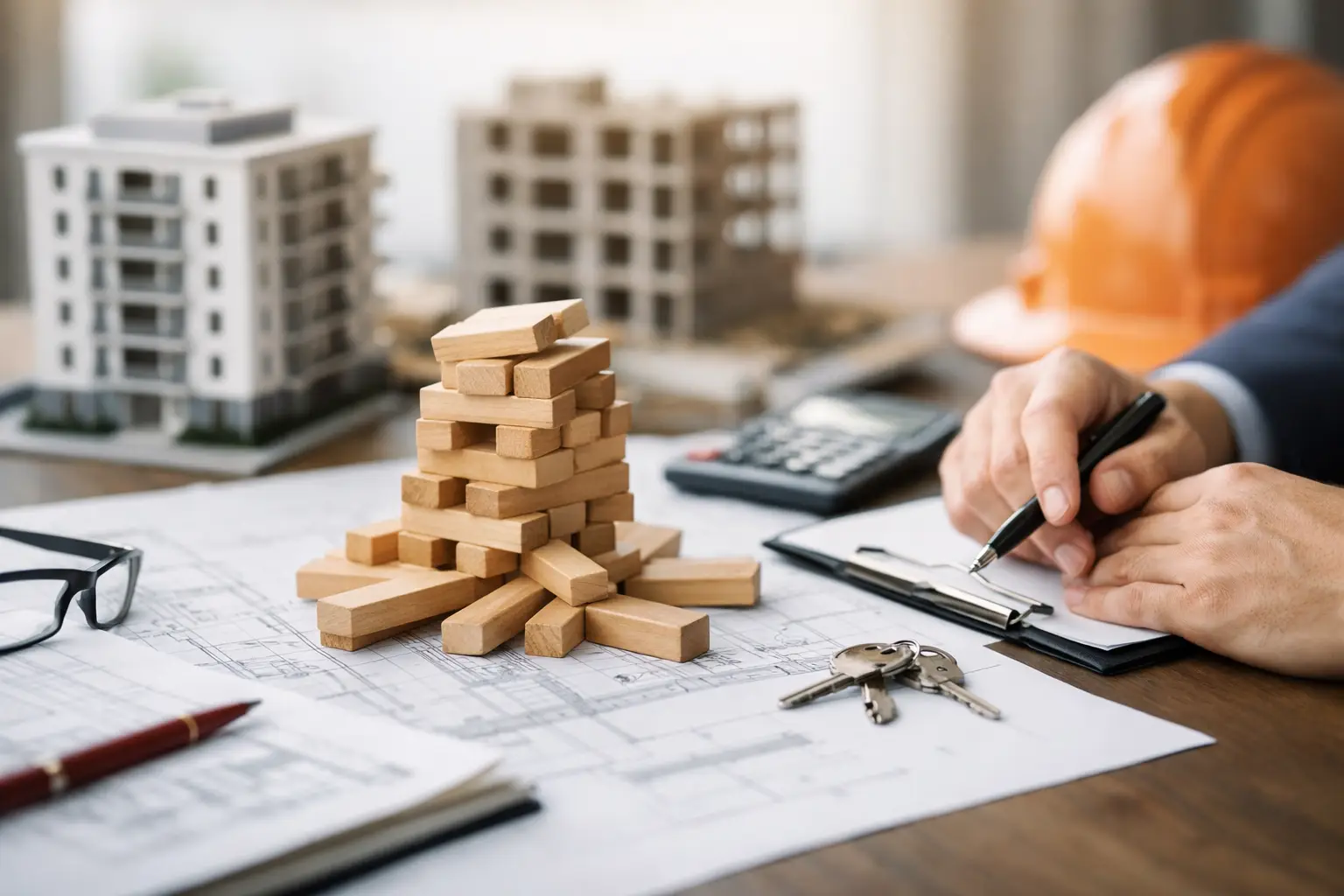
The first serious losses in a development project rarely result from one spectacular mistake. Much more often, it is the result of a series of decisions made too early, too optimistic or without full coordination. This is why mistakes when planning a development investment cost the most – because they only reveal themselves then, when the capital has already been committed, the schedule has started, and the room for maneuver is rapidly shrinking.
A well-planned investment does not start with a vision of the facade or with an Excel with revenues. It starts with a skillful combination of three perspectives: plots, product and business model. If even one of them is treated superficially, the design may look attractive on paper, but lose stability in implementation.
The most common mistakes when planning a development investment
1. Purchase of land without full verification of its potential
This is still one of the most expensive mistakes. Attractive location, a good price and the promise of quick entry into the project can obscure the basic questions: what can actually be built here, at what time and at what level of administrative complexity.
The analysis itself planning provisions is not enough. Access to infrastructure also matters, formal restrictions, environmental conditions, communication system, neighborhood and real opportunities to service the investment. Plot, which seemingly gives a lot of freedom, may generate costly design compromises or a lengthy approval process.
It's not about being conservative at this stage. It's about precision. The land should be assessed not only through the prism of the entry price, but above all by the ability to generate a well-designed and profitable product.
2. Confusing the absorption capacity of the plot with the profitability of the project
To, that a certain number of square meters can fit on a plot, doesn't mean yet, that such a volume should be realized. Rescaling an investment program is a common problem, especially there, where the assumptions of maximizing PUM or GLA dominate without sufficient reflection on the quality of space, product structure and construction cost.
Excessive intensification usually backfires quickly. The project becomes more difficult functionally, less attractive in terms of sales and more demanding in terms of execution. There is poorer lighting, weaker layouts of apartments or premises, more pressure on communication, parking lots and technical solutions. All this reduces the final value, even if it initially improves the metrics on paper.
A strong development investment is not about squeezing the plot of land to its limits. It involves finding the right proportion between the scales, quality and financial result.
3. Lack of a product tailored to real demand
The market does not buy abstract meters. He buys a specific product – with a specific location, standard, arrangement, price and the promise of a lifestyle or use value. One of the most common mistakes is designing investments based on general beliefs about the market, instead of the real profile of the recipient.
In practice, this means premises with an inappropriate structure, too high or too low standard of common areas, incorrect proportions of common to commercial areas or incorrect price positioning. Sometimes the design is aesthetically correct, but it does not meet the needs of the end customer. Other times he has good trading assumptions, but it does not offer the quality of space, that justifies the price.
The best projects are created there, Where architectural concept and sales strategy develop in parallel. The product must be visually attractive, but also clear in business terms. This is especially important in competitive markets, where the customer compares not only the price, but the whole investment experience.
Errors when planning a development investment and the design process
4. Separation of design from investment economics
In premium projects, this error can be particularly dangerous. On the one hand, there is the ambition to create expressive architecture, on the other – budget and schedule pressures. If these two worlds meet only after the concept has been prepared, this is usually where the costly correction begins: cuts, simplification, material compromises and loss of cohesion.
Good architecture is not the opposite of profitability. Contrary – can enhance the value of the investment, provided that it is created with full awareness of costs from the beginning, technology, stage of implementation and market position of the project. The problem starts then, when design becomes an independent layer, rather than an integral part of the investment model.
At QCA, this integration is crucial: projects, interiors and development thinking should work towards one goal, and not be separate processes, which must later be forcefully merged.
5. Underestimating the time and complexity of procedures
Many investors continue to build their schedule around the optimistic scenario. They assume efficient administrative decisions, quick arrangements, no appeals and smooth transition from the concept stage to implementation. Meanwhile, the design reality is more demanding, and the margin of error is small.
Procedural delays affect more than just the calendar. They change financing costs, they postpone the moment of commercialization, they complicate the contracting of contractors and increase the risk of entering the market at a less favorable time. The later the investor takes this fact into account, the more difficult it is to control the entire project.
Sensible planning is not about creating pessimistic scenarios. It involves building a schedule, which takes into account process variability and gives room for corrective decisions without loss of quality.
6. Involvement of a multidisciplinary team too late
If an architect, industry designers, cost estimators, formal advisors and the implementation team work sequentially instead of in parallel, the design quickly loses coherence. This leads to a situation, where an attractive concept turns out to be technically difficult, expensive or impossible to implement without changing the assumptions.
In a development investment, each decision has consequences in several areas at the same time. The arrangement of the body influences the structure, the installations, surface balance, interior standard, cost of implementation and final market acceptance. Coordination too late not only means the risk of errors, but also a waste of time on corrections, which could have been avoided.
The most effective projects are created then, when architectural thinking, implementation and investment has been present from the first stages. This does not lengthen the process. He usually sorts it out.
7. Lack of exit strategy and emergency scenarios
Developers often focus on the baseline scenario: assumed sales pace, expected construction cost and target margin. It's natural, but not enough. Each investment should also have alternative paths of action – in case of changes in material prices, decline in demand, schedule shifts or the need to reposition the product.
The lack of such scenarios does not have to lead to a crisis immediately. More often it causes a series of nervous decisions made under pressure. And then it's easy to lose it, what is most valuable in the project: quality, predictability and control over the investment brand.
Strategic planning does not take away from the project's flexibility. It provides a framework, in which you can react consciously. That's a huge difference.
How to reduce risk at the planning stage
The best protection against error is not too much analysis for analysis's sake. It is the right sequence of decisions. First, you need to understand the limitations and potential of the plot, then define the product, and only then precisely model the scale, standard i harmonogram. When this order is reversed, the project begins to be subordinated to the assumptions, which cannot be defended in practice.
It is equally important to combine design ambition with investment discipline. A well-designed investment not only looks better. It is easier to communicate, more convincing to the market and more resistant to chaotic changes during implementation. The quality of space is commercially important, but only then, when supported by a reasonable cost structure and a realistic schedule.
It's also worth remembering, that planning does not end with obtaining a decision and closing the concept. To proces, which requires constant verification. The market is changing, costs change, and the original assumptions sometimes need to be corrected. The strength of the design is not its rigidity, but the ability to maintain quality and profitability despite changing conditions.
The most successful investments are not the result of chance or pure courage. They are created there, where vision meets precision, and the decisions made at the beginning are as refined as the final architecture. If this stage is taken seriously, the project gains more than just a smooth start – gains foundation, which is really worth building on.